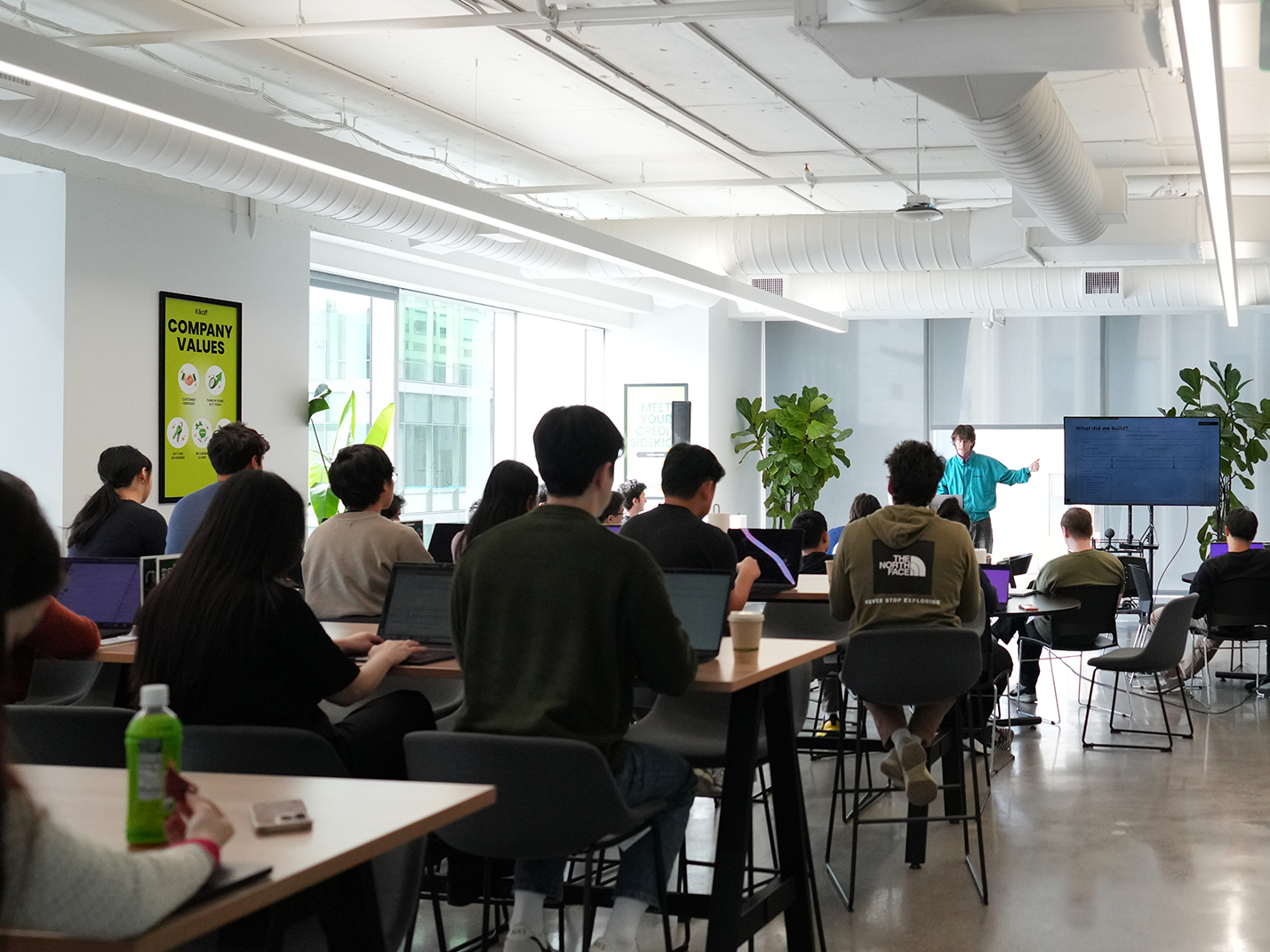
This month, Kikoff hosted AI Day.
The goal was simple: create space for teams to share how they are using AI in their work and what they have learned along the way.
The event was organized by Dmitrii Evstiukhin, Kikoff’s Lead Platform Engineer. When he joined the company, he noticed how quickly the AI landscape was evolving and how much opportunity there was to push its use even further across the company. “I was seeing productivity gains I had never experienced before,” he says. “Using tools like Claude Code, I could execute code faster than I could design it.”
With AI capabilities advancing so quickly, Dmitrii saw an opportunity to bring teams together to share what was working and help everyone move faster.
He organized the first AI Day to share those learnings with the engineering team. This year, the event expanded beyond engineering.
The thinking was straightforward. If AI is becoming a core part of how we build products and tools, everyone should have a chance to learn how to use it effectively.
.jpg)
A Skill Everyone Can Use: Prompting
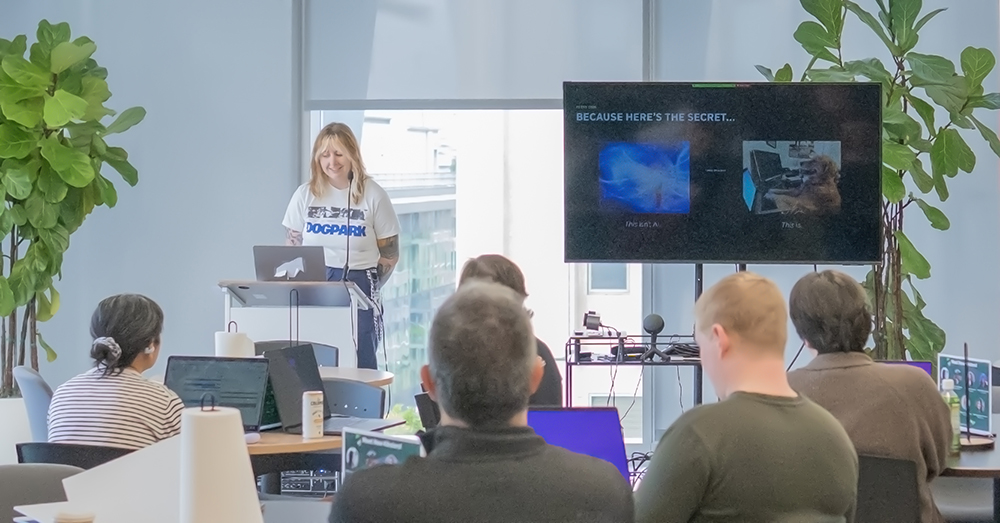
The day opened with a session from Senior Copy Creative, Skyelar MacEachern, who leads Kikoff’s AI creative workflows. Their workshop focused on prompting, one of the most foundational skills for working effectively with AI.
“As a copywriter, I spend a lot of time writing long-form prompts that need to be very specific and detailed,” they explain. “Through a lot of trial and error, I developed my own frameworks and best practices.” Prompting may sound simple, but the difference between basic and expert prompting can dramatically change the output.
“By prompting simply, you're committing to minutes or even hours of back-and-forth to get to a passable final product. When you take the time to prompt at an expert level, you reduce that iteration. You're giving the AI clear objectives, constraints, and standards from the start.”
Skyelar summed it up in a line that resonated across the room: “In this environment, your cognitive energy is the most expensive thing on the balance sheet. Expert prompting isn’t extra work. It’s the only way to make sure the AI is actually working for you.”
AI in Practice
AI Day included a wide range of sessions across engineering, product, design, and marketing.
Among the engineering sessions, several focused on how teams are already applying AI in their workflows:
- Shipping a 316-file migration across 17 PRs using structured markdown files as external memory to manage context resets
- Running parallel and multi-agent workflows to accelerate development
- Building an AI-powered ad performance dashboard to track creative performance in real time
Other workshops explored different experiments and technical challenges, including:
- Using LLMs to standardize credit bureau institution names and tradelines, transforming messy credit report data into something usable for product features
- Claude Code: From subagents to agent teams, exploring how to structure collaborative AI workflows
- Git Worktrees for parallel AI development, including a live demo completing multiple tasks simultaneously
- Vibe engineering at scale and lessons learned from building AI systems in production
- AI inside Figma, showing how design teams can turn concepts into interactive prototypes faster
- From noise to augmented error triage, a proof of concept for AI-assisted debugging
The sessions reflected how widely AI is already being applied across the company.
AI Beyond Engineering
One of the biggest shifts this year was the participation from non-engineering teams.
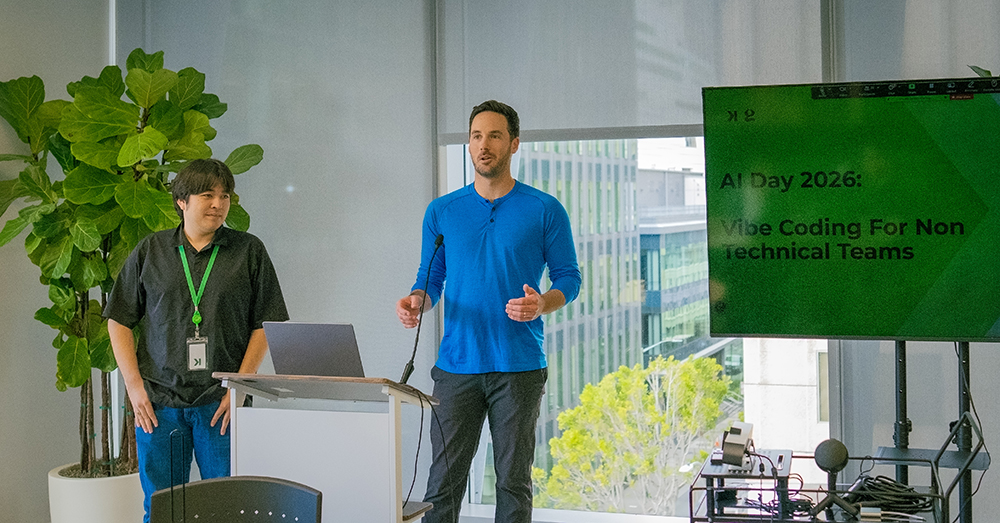
We saw live demos of internal dashboards built without prior coding experience. The marketing team walked through vibecoding workflows aimed at automating repetitive tasks, with a goal of removing 10,000 manual hours from marketing operations. Designers demonstrated rapid prototyping with AI-assisted tools to iterate faster and share concepts earlier in the process.
For many participants, the biggest takeaway was how accessible these tools have become. Several engineers commented on how impressed they were by the creativity and practicality of the solutions coming from non-technical teams. Seeing colleagues build internal tools, automate workflows, and prototype new ideas without traditional engineering backgrounds showed just how quickly the definition of “who gets to build” is expanding.
One non-technical team member shared:
“We loved how non-engineering team members could participate, gain value, and even come out of the day with something new built that we had never built before. We never knew how empowering it was. Now I have dozens of ideas I want to bring to life.”

Building the Infrastructure for AI Products
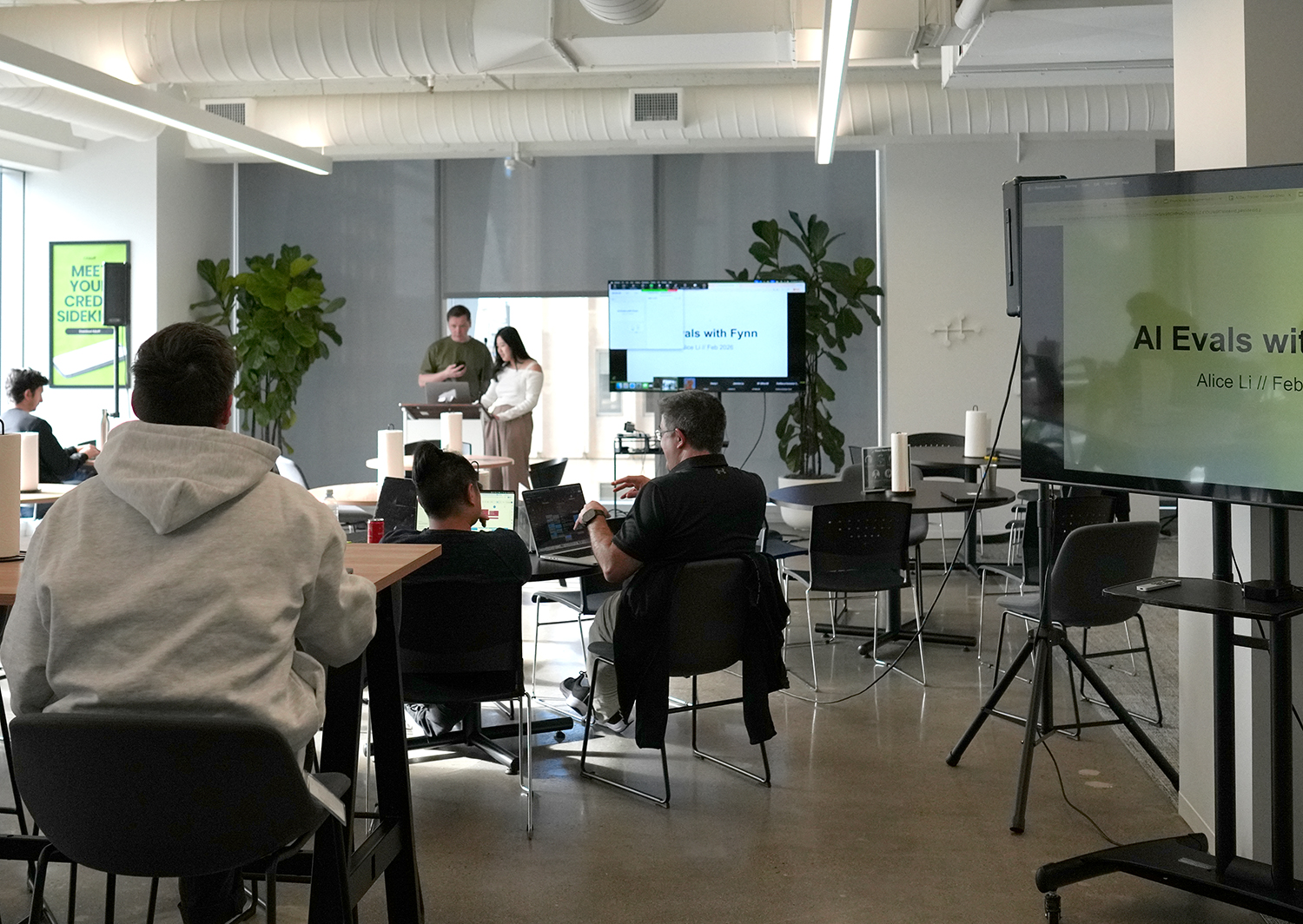
Alice Li, a member of the data team who works on Kikoff’s AI credit coach Fynn, shared her work on evaluation systems for AI responses. “I own the evals workstream for Fynn,” she explains. “At its core, evals are about defining what ‘good’ looks like.”
Her work combines product management and data science. The team built automated scorers that evaluate Fynn’s responses across dimensions like accuracy, tone, compliance, and privacy.
The motivation was simple: manual review does not scale. “We couldn’t have humans review every response consistently, and we had no systematic way to test prompt changes before they went live,” she says. Automated scoring systems allow the team to evaluate responses at scale and test improvements before they ship. “Using AI to judge another AI might sound meta,” she adds. “But verifying an answer is a narrower task than generating one. It’s easier to critique than to create.”
Her workshop focused on making AI evaluation less mysterious and more structured. “Building evals forces you to get concrete about what success means,” she says. “The methodology we built for Fynn is something we hope becomes quality infrastructure for future AI products at Kikoff.”
Kikoff and The Red Queen Hypothesis
Andy Yin, a Computer Systems Analyst at Kikoff, closed the day by stepping back and connecting the themes of AI Day to a broader idea: the Red Queen Hypothesis.
The theory from evolutionary biology suggests that survival is not about being the strongest. It is about adapting quickly enough to keep up with your environment. Species that fail to evolve eventually fall behind.
The name comes from Through the Looking Glass, where the Red Queen tells Alice:
“It takes all the running you can do to stay in the same place.”
To move forward, you have to run even faster.
Andy sees a clear parallel in technology and fintech.
“When Kikoff started, we entered a market with strong players that had been around for decades,” he explains. “If we wanted to compete, we needed to outperform them in the areas that mattered most to our customers.” For Kikoff, that meant building simpler, more affordable tools that removed barriers to building credit.
Today, the environment is shifting again. “The industry is evolving quickly as companies figure out how AI fits into their products and services,” Andy says. “Companies that integrate AI well will have a competitive advantage.”
At Kikoff, adapting early and moving quickly has always been part of how we operate. AI Day reflects that mindset. Teams across the company are experimenting, learning, and applying new tools in real workflows so we can keep building better products for our customers. As Andy put it: “The question is no longer just what you know. It’s what you can imagine, and how precisely you can ask for it.”




.png)